What is Bing Webmaster Tools AI reporting: Bing Webmaster Tools AI reporting is the new AI Performance reporting experience in Bing Webmaster Tools that shows how publisher content is cited across Microsoft Copilot, AI-generated summaries in Bing, and select partner integrations. Microsoft introduced AI Performance as a public preview on February 10, 2026, giving site owners a clearer way to measure citations, cited URLs, grounding query phrases, page-level citation activity, and citation trends over time.
This update matters because AI search visibility is not the same as traditional organic search visibility. A page can influence an answer, build brand familiarity, and support a B2B SaaS buyer’s research journey even when the user does not click a classic search result. The official Bing announcement frames AI Performance as an early step toward Generative Engine Optimization tooling inside Bing Webmaster Tools, which makes it important for B2B SaaS SEO, content, and PPC teams to understand what the report can and cannot measure.
TL;DR
- Bing introduced AI Performance in Bing Webmaster Tools as a public preview on February 10, 2026.
- The report focuses on AI citations, cited pages, grounding query phrases, page-level citation activity, and visibility trends.
- The data covers Microsoft Copilot, AI-generated summaries in Bing, and select partner integrations.
- AI Performance does not replace rankings, clicks, or normal search performance reporting.
- B2B SaaS teams can use the report to connect cited pages with demand generation, paid search, and content strategy.
- Publishers should use the report to improve clarity, structure, evidence, freshness, and entity consistency.
What did Bing officially announce?
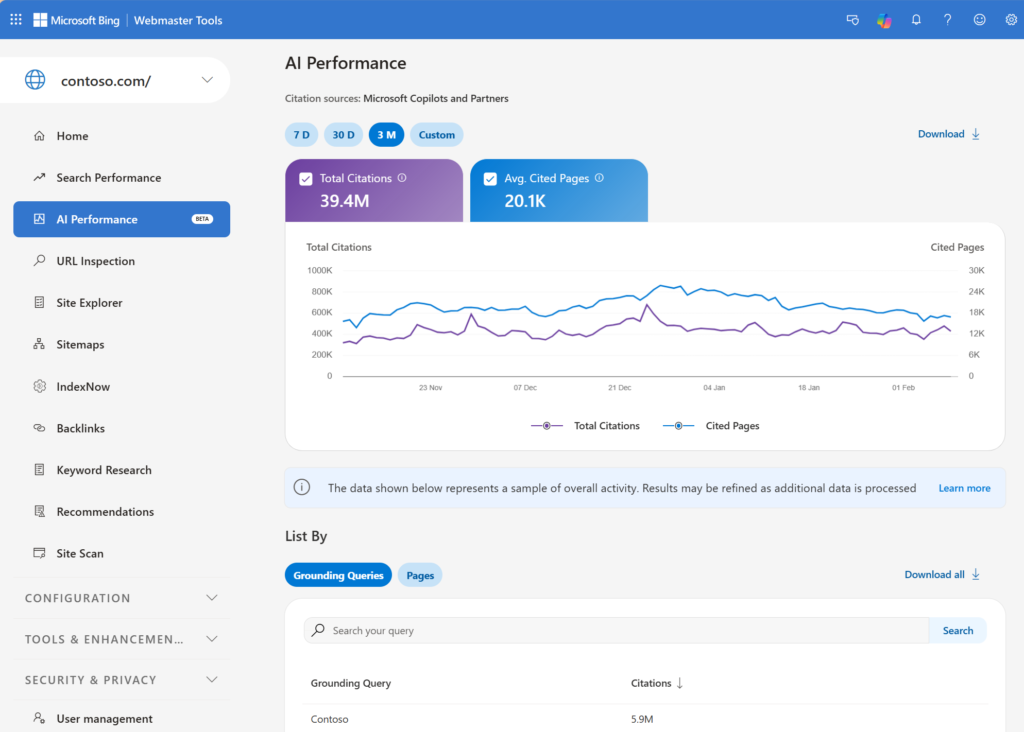
Bing announced AI Performance in Bing Webmaster Tools, a public preview designed to show how publisher content appears as cited sources in Microsoft AI experiences. The announcement specifically mentions Microsoft Copilot, AI-generated summaries in Bing, and select partner integrations.
The important part is attribution. Instead of asking publishers to guess whether their pages are being used in AI answers, Bing is giving verified site owners a reporting layer for citation activity. That makes the tool useful for understanding where your content is already participating in AI-driven discovery.
For PPC and search teams, the announcement is also a signal. Search platforms are moving from simple query-result pages toward AI-mediated answer journeys. Measurement needs to catch up with that shift.
What does Bing Webmaster Tools AI reporting measure?
Bing’s official announcement describes five practical reporting areas inside AI Performance. These are the safest metrics to reference because they come directly from the public preview announcement.
| Metric or report area | What it tells you | What it does not prove |
|---|---|---|
| Total Citations | How many times your content was displayed as a source in AI-generated answers during the selected time frame. | It does not show ranking position, placement, or how prominently the source appeared inside an answer. |
| Average Cited Pages | The average number of unique pages from your site cited per day during the selected time range. | It does not mean those pages have higher authority or stronger ranking power. |
| Grounding Queries | Key phrases the AI used while retrieving content that was referenced in AI answers. | Bing says this represents a sample of citation activity, not a complete query universe. |
| Page-level Citation Activity | Which URLs from your site are most often cited across AI-generated answers. | It reflects citation frequency, not page importance, ranking, or answer placement. |
| Visibility Trends | How citation activity changes over time across supported AI experiences. | It does not isolate every cause of movement, such as seasonality, content changes, or AI system updates. |
Why is Bing Webmaster Tools AI reporting important for GEO?
Bing Webmaster Tools AI reporting is important for GEO because it gives publishers a starting point for measuring AI answer visibility. Classic SEO tools usually focus on rankings, impressions, clicks, crawl health, and indexed pages. AI Performance adds a different layer: whether your content is being used as a source when AI systems generate answers.
That does not mean every citation is equally valuable. A cited page may or may not drive a click. It may appear in a research answer that influences a later branded search, a direct visit, a paid search click, or a sales conversation. The point is that AI citations are now visible enough to include in content performance discussions.
This is especially useful for teams already tracking AI search and paid search automation. If you follow changes like AI Max for Search Ads or broader AI tooling trends, Bing’s AI Performance report fits the same pattern: search is becoming more automated, more answer-led, and more dependent on clear, structured content.
How can B2B SaaS teams use Bing Webmaster Tools AI reporting?
B2B SaaS teams should use Bing Webmaster Tools AI reporting to find which educational, comparison, and problem-aware pages are already being cited in AI-generated answers. Those pages often sit before the demo request, free trial, or sales conversation, so AI citation visibility can help explain early-stage demand that does not show up cleanly in last-click reporting.
A practical B2B SaaS workflow is to map cited URLs to funnel intent:
| B2B SaaS page type | What to look for in AI Performance | Best optimization move |
|---|---|---|
| Problem and category guides | Grounding Queries tied to pain points, definitions, and category education. | Add concise definitions, use-case sections, FAQs, and stronger internal links to product pages. |
| Comparison pages | Page-level citation activity around alternatives, tradeoffs, and vendor research. | Clarify positioning, add evidence, and explain fit by company size, role, and use case. |
| Integration or workflow pages | Citations around setup, data flow, reporting, or implementation questions. | Use step-by-step sections, screenshots, structured lists, and fresh product details. |
| Benchmark and research pages | Repeated citations where AI answers need data, examples, or credible support. | Keep numbers current, cite sources, and make key findings easy to extract. |
This is where B2B SaaS SEO and PPC strategy start to overlap. A cited guide may not create an immediate form fill, but it can shape how a buyer understands the category before they search your brand, click a paid ad, or enter a remarketing audience.
How should publishers interpret Total Citations?
Total Citations should be interpreted as a visibility signal, not a ranking metric. It shows how often content from your verified site was displayed as a source in AI-generated answers during the selected time frame.
A rising citation count can suggest that your content is becoming more visible in AI answer experiences. A falling count may suggest weaker fit, reduced demand, freshness issues, changed retrieval patterns, or normal fluctuation. Bing does not present this metric as a direct measure of authority, conversion value, or answer placement.
The practical move is to compare Total Citations with other signals. Look at cited pages, grounding phrases, organic search performance, branded search volume, direct traffic, and assisted conversions. That combination gives a better picture than citation counts alone.
What are Grounding Queries and why do they matter?
Grounding Queries are key phrases the AI used while retrieving content that was referenced in AI-generated answers. They matter because they reveal the language and topics that connect your pages to AI answers.
Bing notes that this data is a sample of overall citation activity. That caveat is important. You should not treat Grounding Queries like a complete keyword report. Instead, use them as directional clues for content structure, topical depth, and answer clarity.
For example, if a B2B SaaS guide is cited around setup questions but not comparison questions, the page may need stronger sections for alternatives, tradeoffs, pricing logic, or use cases. If a PPC article is cited around definitions but not implementation, it may need clearer steps, screenshots, or examples.
How can marketers use page-level citation activity?
Page-level citation activity helps teams identify which URLs are already being used as sources in AI-generated answers. That is valuable because it turns AI visibility from an abstract concept into a page-level content workflow.
Start by grouping cited URLs into three buckets:
- Strong pages: Pages with frequent citations, clear structure, fresh information, and obvious topical authority.
- Opportunity pages: Pages with some citation activity but weak examples, thin sections, missing FAQs, or outdated claims.
- Underperforming pages: Important pages that are indexed but rarely cited for the topics they should own.
From there, improve the pages that already show promise. Add clearer headings, tighter definitions, short answer blocks, comparison tables, cited sources, and concise FAQ sections. PPCBlogPro already uses this type of cluster thinking across topics like Google Ads for B2B SaaS, AI tools for PPC management, and Google AI Max updates.
What content improvements does Bing recommend?
Bing’s announcement gives a clear content optimization direction. The advice is not to manipulate AI systems. It is to make high-value pages more complete, clearer, better supported, and easier to understand.
| Bing recommendation | What to do in practice | Why it helps |
|---|---|---|
| Strengthen depth and expertise | Expand thin sections, add related subtopics, and answer follow-up questions. | Pages with clear subject focus are easier to match to specific AI retrieval needs. |
| Improve structure and clarity | Use descriptive headings, tables, step lists, and FAQ sections. | Structured content makes key information easier to reference accurately. |
| Support claims with evidence | Add examples, data points, screenshots, sources, and transparent caveats. | Evidence improves trust when content is reused in AI-generated answers. |
| Keep content fresh and accurate | Refresh outdated examples, product details, screenshots, and recommendations. | AI systems should reference the most current version of a page. |
| Reduce ambiguity across formats | Align text, images, and video around the same entities, products, and concepts. | Consistent signals reduce confusion for users and retrieval systems. |
Where does IndexNow fit into AI visibility?
Bing connects AI Performance with freshness and IndexNow. The logic is straightforward: if content changes, search engines and AI experiences need to discover that change quickly enough to use the current version.
IndexNow allows sites to notify participating search engines when pages are added, updated, or removed. For publishers running frequent content updates, product changes, or news posts, IndexNow can support faster discovery of those changes.
For PPC and marketing sites, this is practical. When a platform feature changes, update the article, submit the change through IndexNow where available, and watch whether AI Performance citation trends or cited pages change later. Do not expect instant causation, but do use the workflow consistently.
What should local businesses know?
Bing’s announcement includes a separate note for local businesses. When AI experiences answer location-based questions, accurate business information becomes a visibility factor in a very practical sense.
Local businesses should keep site content current, use Bing Webmaster Tools, and register with Bing Places for Business. Core details such as address, hours, phone number, and contact information should match across the website and business listings.
This is not only a local SEO habit. It is also a way to reduce ambiguity when AI systems summarize business information for users.
What does this mean for B2B SaaS PPC teams?
B2B SaaS PPC teams should treat Bing Webmaster Tools AI reporting as an upper-funnel visibility signal. It will not tell you cost per lead, conversion rate, pipeline value, or campaign profitability. It can help explain how content is influencing the discovery stage before paid clicks happen.
That matters because B2B SaaS buyers often move across multiple surfaces before converting. They may read an AI answer, search the brand later, click a paid ad, compare vendors, join a retargeting pool, and then convert days or weeks later. If cited pages are also landing pages, pillar pages, or comparison assets, AI citation visibility becomes part of the broader demand-generation picture.
The next step is to connect AI Performance with other reporting layers. Compare cited pages against paid search landing pages, branded search trends, assisted conversion paths, sales-qualified pipeline, and CRM source data. This is similar to the mindset behind LinkedIn Ads revenue attribution tools, where one channel rarely gets the whole story by itself.
Direct answer: should you optimize for AI citations?
Yes, but the right goal is not to chase citations at any cost. Optimize for clear, trustworthy, well-structured pages that answer real user questions. Bing Webmaster Tools AI reporting can show which pages are already being cited, but the long-term win is better content quality, stronger topical coverage, and more accurate information.
Practical AI Performance checklist
- Verify the site in Bing Webmaster Tools.
- Check whether AI Performance is available for the property.
- Review Total Citations and visibility trends for directional movement.
- Export or document cited URLs and grounding query phrases.
- Identify pages with citation activity but weak structure or outdated information.
- Add clearer headings, concise definitions, tables, steps, examples, and FAQs.
- Use credible sources when making claims that need support.
- Use IndexNow after meaningful updates when your site supports it.
- For B2B SaaS pages, connect cited guides to product pages, comparison pages, demo CTAs, and paid search landing pages.
- Compare AI citation trends with organic traffic, branded search, and paid search behavior.
Frequently Asked Questions
What is Bing Webmaster Tools AI reporting?
Bing Webmaster Tools AI reporting is the AI Performance public preview that shows how verified site content is cited across Microsoft Copilot, AI-generated summaries in Bing, and select partner integrations.
What does AI Performance in Bing Webmaster Tools measure?
AI Performance measures Total Citations, Average Cited Pages, Grounding Queries, page-level citation activity, and visibility trends over time.
Are AI citations the same as organic rankings?
No. AI citations show when content is displayed as a source in AI-generated answers. They do not show classic ranking position, authority, answer placement, or conversion value.
What are Grounding Queries in Bing Webmaster Tools?
Grounding Queries are key phrases the AI used while retrieving content that was referenced in AI-generated answers. Bing describes this as a sample of citation activity.
How can publishers improve AI citation visibility?
Publishers can improve pages by strengthening depth, improving headings and structure, adding tables and FAQs, supporting claims with evidence, keeping content fresh, and reducing ambiguity across text, images, and video.
Does IndexNow help with AI visibility?
IndexNow can help participating search engines discover added, updated, or removed content faster, which supports freshness for search and AI experiences.
How should B2B SaaS marketers use AI Performance data?
B2B SaaS marketers should map cited pages to funnel intent, improve high-value educational and comparison pages, and compare AI citation trends with branded search, paid search, pipeline, and CRM data.
Conclusion
Bing Webmaster Tools AI reporting is a useful step toward practical GEO measurement because it gives publishers visibility into AI citations, cited URLs, grounding query phrases, page-level citation activity, and citation trends. It does not replace classic SEO, paid search analytics, or conversion reporting, but it adds a new layer for understanding how content participates in AI-generated answers.
The best response is simple: use the official AI Performance report as a diagnostic tool, refresh pages that already show citation potential, make important content easier to parse, and keep evidence and business information current. For B2B SaaS marketers, the bigger takeaway is that AI search visibility now belongs in the same strategic conversation as SEO, content, paid search, demand generation, and attribution.