Meta’s Andromeda update has fundamentally transformed how advertisers should structure their Facebook and Instagram campaigns. This shift marks the most significant evolution since the launch of Advantage+ campaigns in 2022. If your ad performance has plateaued or you’re still relying on complex audience segmentation, it’s time to rethink your approach. In this guide, you’ll learn the optimal Meta Andromeda Campaign Structure that top advertisers are using to simplify setup, improve efficiency, and unlock stronger performance with far less manual work.
What is Meta Andromeda?
Andromeda is Meta’s new retrieval engine that takes millions of ads, narrows them to a few thousand candidates, and does so in a way Meta claims is faster, smarter, and more personal than before. This innovative AI-driven retrieval system was introduced in 2024 and completed its global rollout in October 2025.
The system enabled a 10,000x increase in the complexity of models used for ads retrieval, the first step in the ranking process where Meta narrows down a pool of tens of millions of ads to the few thousand it considers showing someone.
The critical difference? Andromeda’s intelligence doesn’t just ask “who should see this ad?” It now asks “which ad should this person see?” This level of personalization means Meta can interpret thousands of engagement and behavioral signals to make real-time decisions about which creative variation is most relevant to each individual user.
The Old Way vs. The New Way
Traditional Campaign Structure (Pre-Andromeda)
The old approach involved:
- Multiple campaigns for different objectives
- 5-10 ad sets per campaign targeting specific interests or demographics
- 3-6 ads per ad set (Meta’s previous recommendation)
- Fragmented budgets across dozens of audience segments
- Obsessive focus on interest stacking and lookalike audiences
This structure made intuitive sense when manual targeting was king, but it’s now working against Meta’s AI capabilities.
Andromeda-Optimized Structure
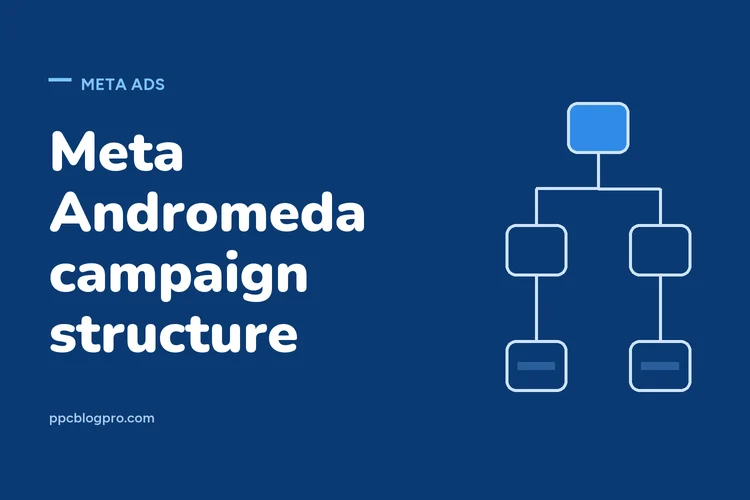
Meta’s system now prefers simplified campaign structures with fewer ad sets and more creative inputs per ad set. The winning formula looks like this:
- One campaign per conversion objective (purchase, lead, app install)
- One primary ad set with broad targeting
- 10-50+ diverse creative variations within that ad set
Testing showed 17% more conversions at 16% lower cost using one ad set with 25 creatives versus five ad sets with five creatives each.
Why Simplified Structures Win With Andromeda
Andromeda works by matching specific creative variations to individual users based on their behavior, interests, and position in the buyer’s journey. When you fragment your budget across multiple ad sets, you’re limiting the algorithm’s ability to learn and optimize effectively.
Because Andromeda needs data density, if you split your budget across 10 different campaigns, you’re depriving the algorithm of data.
With consolidated structures, creative has become the primary mechanism for reaching different customer segments. Your ads now do the targeting work that audience parameters used to handle. Early tests, including Meta’s own internal data, suggest average performance improvements of 8% to 10% when campaigns are correctly structured.
Building Your Meta Andromeda Campaign Structure
Step 1: Consolidate Your Campaigns
Start by running one campaign per business objective. If you’re driving purchases, create a single Purchase campaign rather than splitting it across multiple demographic-focused campaigns.
Stop splitting budgets across five campaigns chasing the same goal. Consolidate and give Meta more data to learn from and optimize faster.
Step 2: Use Broad Targeting
Targeting largely happens in the ad now. Instead of obsessing over age, gender, or interest levers, focus on ads that speak to the people you want. Keep ad sets broad and let Andromeda match.
Key targeting recommendations:
- Location: Your target markets only
- Age: Keep as broad as possible (18-65+)
- Gender: All unless absolutely product-specific
- Detailed targeting: None or minimal
- Strategic exclusions: Recent customers, past converters (let email handle repeat buyers)
If you see returning customers increasing while new customers are decreasing, add those exclusions immediately. Your goal is strong customer acquisition, not just good Meta platform ROAS.
Important note: If you’re starting from scratch and are new to ads, Andromeda does still need a little direction. You might start with some light targeting guardrails, then remove them once Meta has enough conversion data (typically 50+ events).
Step 3: Maximize Creative Diversity (This Is Critical)
This is where the magic happens. Creative diversity isn’t about pumping out 20 versions of the same product video with different hook variations. Meta’s system can recognize near-duplicates and will very often ignore redundant ads altogether.
Diversity means giving the algorithm distinct creative signals, NOT just new looks.
Create 10-50 meaningfully different ads that explore:
Different Value Propositions:
- Price/affordability messaging
- Premium quality/luxury positioning
- Convenience/time-saving benefits
- Social status/exclusivity angles
- Transformation/results-focused
Various Formats:
- User-generated content (UGC) videos
- Professional product photography
- Product demonstration videos
- Behind-the-scenes footage
- Customer testimonials
- Before/after comparisons
- Carousel ads with multiple products
- Single image ads with text overlays
- Lifestyle imagery
- Founder story content
Multiple Emotional Angles:
- Aspiration: “Become the person you want to be”
- Problem-solution: “Struggling with X? Here’s the fix”
- Social proof: “Join 10,000+ happy customers”
- FOMO: “Limited time opportunity”
- Transformation: “How I went from X to Y”
- Belonging: “Find your community”
Diverse Hooks and Storytelling:
- Question hook: “Ever wondered why…?”
- Bold statement: “Most people get this wrong…”
- Story-driven: “Three months ago, I was…”
- Direct CTA: “Stop scrolling. You need to see this.”
- POV format: “As someone who…”
- Listicle: “5 reasons you need…”
Meta’s Top 10 Content Topics for Diversification:
Meta has identified the top 10 content topics that advertisers can use to diversify their messaging strategy. These are ad types that cater to more than just in-market shoppers. They offer comparison, emotion, education – all aspects of a story-driven narrative:
- Product demos showing how it works
- Customer testimonials and reviews
- UGC and authentic user experiences
- Features and benefits highlights
- Brand origin stories
- Comparison content (before/after, us vs. them)
- Educational content answering questions
- Promotional offers and deals
- Versatility demonstrations (multiple use cases)
- Behind-the-scenes and founder content
What Doesn’t Count as Creative Diversity:
Small changes like the same visual video frames in a hook but with a slightly different voiceover, slightly different video but from the same video shoot, or multiple hooks that essentially say the same thing but with slightly different order of words don’t count.
Changing just the background color, swapping a headline while keeping the same visual, or minor text tweaks are NOT meaningful diversity.
Step 4: Enable Advantage+ Features
Use Meta’s automated placement and delivery options. In most cases, Advantage+ campaigns are the cleanest fit. These tools are specifically designed to work with Andromeda’s AI capabilities and typically outperform manual settings.
Consider using:
- Advantage+ Placements (automatic placement optimization)
- Advantage+ Creative (automatic text variations and enhancements)
- AI-generated backgrounds
- Flexible Format (automatically creates carousels from your images)
- Dynamic Creative (mix and match up to 10 images/videos with different text)
Step 5: Set Appropriate Budgets
Ensure enough daily budget to generate at least 50 conversion events per week. This gives Andromeda sufficient data to learn which creatives resonate with which audience segments.
Instead of many ad sets each with small budgets, consolidate so more budget flows into fewer ad sets, enhancing algorithm learning.
The Two-Campaign Framework for Testing and Scaling
Many successful advertisers use a dual-campaign approach based on this principle: ABO is where you learn, and CBO is where you earn.
Testing Campaign (ABO – Ad Set Budget Optimization)
- Purpose: Identify winning creatives
- Structure: Multiple ad sets with 3-5 unique concepts each
- Budget: $20-50 per ad set daily
- Goal: Gather insights and test new concepts
- Review frequency: Weekly
Scaling Campaign (CBO – Campaign Budget Optimization)
- Purpose: Amplify proven winners
- Structure: One ad set with 20-50 winning ads
- Budget: Majority of your ad spend (70-80%)
- Goal: Maximum profitability
- Maintenance: Add new winners weekly
Once an ad generates 10+ conversions at your target cost per acquisition in the testing campaign, graduate it to the scaling campaign.
Creative Refresh Cycles: Fighting Fatigue
Rotate hooks weekly, angles bi-weekly, and formats monthly to fight fatigue. Creative fatigue happens when audiences see your ads too frequently, causing engagement and conversion rates to drop.
Refresh strategy:
- Replace your worst performers every 7-14 days
- Add 3-5 new creative concepts weekly
- Monitor frequency metrics (aim to keep below 3 impressions per user per week)
- When creative diversity is baked in, fatigue curves flatten because Meta rotates more effectively between styles
Meta is rolling out a Creative Similarity Report that highlights creative fatigue, creative similarity issues, and top creative themes driving engagement.
Essential Performance Rules
Stop Loss Rule: If an ad spends twice your target CPA without conversions, turn it off immediately. Andromeda cuts underperforming ads faster than the old system, so initial traction matters.
Trim the Fat: Remove ad sets that generate sales but exceed your target CPA by 20% or more.
Budget Bump Protocol: Sudden big budget jumps or aggressive scaling may confuse the algorithm. Increase gradually so the system can adapt. When an ad set hits your KPIs consistently for 3-4 days, increase budget by 15-20% every 1-2 days.
Learning Phase Protection: Making significant changes before your campaign completes its learning phase (typically 50 conversions) resets progress. Avoid major edits during this critical period.
Creative Volume Scaling: Meta’s own internal guidance suggests 10–15 distinct creative types per campaign is the sweet spot for broad learning (depending on account spend). Those creatives don’t have to all launch at once, rotate new ones in every week or two.
Key Metrics to Track in the Andromeda Era
Since targeting is less manual now, evaluate performance at campaign or ad set level rather than obsessing over tiny audience segments.
Primary Business Metrics:
- Return on Ad Spend (ROAS)
- Marketing Efficiency Ratio (MER) – total revenue divided by total ad spend
- Customer Acquisition Cost (CAC)
- Cost Per Conversion
- New customer percentage vs. returning customers
Creative Performance Indicators:
- Hook Hold Rate (0-3 seconds): Critical for first impressions
- Thumb-Stop Rate: How often people pause on your ad
- View-Through Rate: Completion percentage for videos
- Click-Through Rate (CTR): Andromeda cuts underperforming ads faster, so initial traction matters
- Cost Per 1,000 Impressions (CPM): Accounts feeding 10–15 unique creative types per campaign often see CPM compression and steadier delivery
Platform-Specific Insights: Ads that lead with emotional hooks in the first two seconds, use multiple audio layers, and feature real people on screen are the ones that resonate most. Reels that included both expressive sound and a visible human presence saw 8% more conversions per dollar than those that didn’t.
Important perspective shift: Stop obsessing over which specific ad “won.” The “winner” for one person may flop for another. Andromeda personalizes delivery so the right person sees the right variation.
Common Mistakes to Avoid
Over-segmentation: Creating separate campaigns for men and women, different age groups, or various interests splits your learning phase and reduces algorithmic efficiency. The old game of stacked interests and hyper-specific audiences is over.
Insufficient creative variety: Running 3-4 similar ads doesn’t give Andromeda enough options to personalize effectively. Minor edits no longer cut it. To succeed, advertisers now need to produce distinct concepts.
Premature optimization: Making changes before your campaign exits learning phase (typically 50 conversions) resets progress and costs you time and money.
Ignoring exclusions: Failing to exclude existing customers wastes budget on people who should be in your email funnel. Andromeda was finding people most likely to convert and kept circling back to existing customers and site visitors. The algorithm was gaming its own metrics by going after the easiest conversions, not new customer acquisition.
Treating AI tools as optional: Over 4 million advertisers now use at least one AI-powered creative tool each month. Campaigns using AI-generated imagery saw improved performance. Don’t leave these tools on the table.
Resistance to automation: Resisting automation will ultimately prove to be futile. The machines are here and they are taking over. The marketers who thrive in 2025 won’t be those who resist automation, but those who master the art of creative strategy within algorithmic frameworks.
Your 30-Day Implementation Plan
Week 1: Audit and Consolidate
- Pull up all active campaigns with the same objective
- Identify your top 5-10 performing ads (by conversions, not just spend)
- Create one new campaign with one ad set
- Set broad targeting (remove all detailed targeting)
Week 2: Creative Expansion
- Analyze what’s working and identify themes
- Produce 10-15 new diverse creatives covering different angles
- Use the value proposition + format + emotional angle framework
- Implement AI tools for background variations
Week 3: Launch and Monitor
- Launch your new consolidated campaign
- Monitor learning phase progress (need 50 conversions)
- Track hook hold rate and early engagement signals
- Don’t make changes yet but let it learn
Week 4: Optimize and Scale
- Remove clear losers (ads spending 2x target CPA with no results)
- Graduate winners to a scaling campaign if using the dual-campaign approach
- Plan your creative refresh calendar (add 3-5 new ads weekly)
- Increase budgets gradually on winning ad sets (15-20% every 2 days)
The Bottom Line
Targeting is dead. Creative is the new targeting. Structure is the new strategy. And speed is the new advantage.
The Meta Andromeda campaign structure represents a fundamental shift from advertiser-controlled targeting to AI-driven creative matching. Success in this new era requires advertisers to simplify their campaign construction while deepening their creative strategy.
Spend less time tweaking audiences and more time producing diverse, compelling ads that speak to different customer motivations. Scale now comes from creative breadth, not complexity.
The brands winning with Andromeda aren’t necessarily those with the biggest budgets—they’re the ones producing creative variety at scale and trusting the algorithm to handle the rest.
Ready to restructure your campaigns? Start with consolidation, amplify your creative production using the frameworks in this guide, and let Andromeda’s AI do what it does best: connecting the right message with the right person at the right moment.
The upside for marketers who adapt? Brands that build diverse, high-signal assets see Meta’s AI do the heavy lifting on placement and optimization. Less manual work, better results, and campaigns that scale sustainably into 2025 and beyond.
Read more on this topic:
Meta’s Andromeda Update: The Complete Guide for Advertisers in 2025